OPERATING AGREEMENT FOR
[LLC NAME]
A MEMBER-MANAGED LLC
I. PRELIMINARY PROVISIONS
(1) Effective Date: This operating agreement of [LLC NAME] effective [DATE OF AGREEMENT], is adopted by the members whose signatures appear at the end of this agreement (the “Agreement”).
(2) Formation: This limited liability company (LLC) was formed by filing Articles of Organization, a Certificate of Formation or a similar organizational document with the LLC filing office of the state of [STATE] on [ARTICLES OF ORGANIZATION DATE]. A copy of this organizational document has been placed in the LLC’s records book.
(3) Name: The formal name of this LLC is as stated above. However, this LLC may do business under a different name by complying with the state’s fictitious or assumed business name statutes and procedures.
(4) Registered Office and Agent: The registered office of this LLC and the registered agent at this address are as follows:
[AGENT NAME]
[AGENT ADDRESS]
The registered office and agent may be changed from time to time as the members may see fit, by filing a change of registered agent or office form with the state LLC filing office. It will not be necessary to amend this provision of the operating agreement if and when such a change is made.
(5) Business Purposes: The specific business purposes and activities contemplated by the founders of this LLC at the time of initial signing of this agreement consist of the following:
[BUSINESS PURPOSE]
It is understood that the foregoing statement of purposes shall not serve as a limitation on the powers or abilities of this LLC, which shall be permitted to engage in any and all lawful business activities. If this LLC intends to engage in business activities outside the state of its formation that require the qualification of the LLC in other states, it shall obtain such qualification before engaging in such out-of-state activities.
(6) Duration of LLC: The duration of this LLC shall be Perpetual. Further, this LLC shall terminate when a proposal to dissolve the LLC is adopted by the membership of this LLC or when this LLC is otherwise terminated in accordance with law.
II. MEMBERSHIP PROVISIONS
(1) Non-liability of Members: No member of this LLC shall be personally liable for the expenses, debts, obligations or liabilities of the LLC, or for claims made against it.
(2) Reimbursement for Organizational Costs: Members shall be reimbursed by the LLC for organizational expenses paid by the members. The LLC shall be authorized to elect to deduct organizational expenses and start-up expenditures ratably over a period of time as permitted by the Internal Revenue Code and as may be advised by the LLC’s tax advisor.
(3) Management: This LLC shall be managed exclusively by all of its members.
(4) Members’ Percentage Interests: A member’s percentage interest in this LLC shall be computed as a fraction, the numerator of which is the total of a member’s capital account and the denominator of which is the total of all capital accounts of all members. This fraction shall be expressed in this agreement as a percentage, which shall be called each member’s “percentage interest” in this LLC.
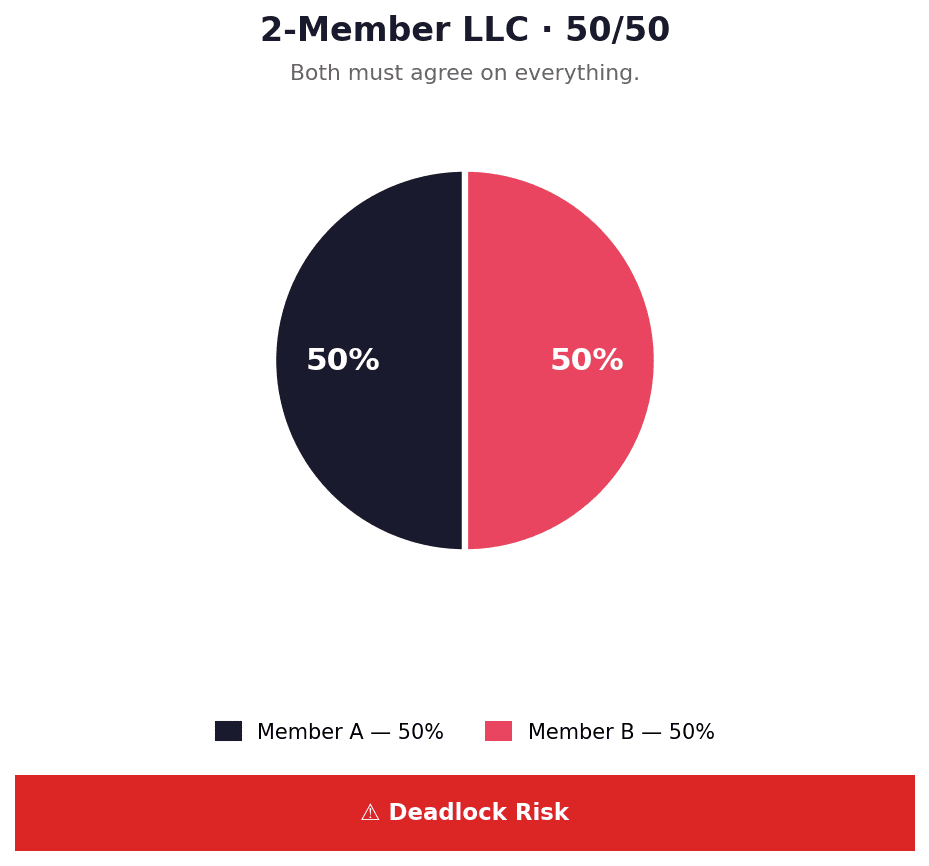
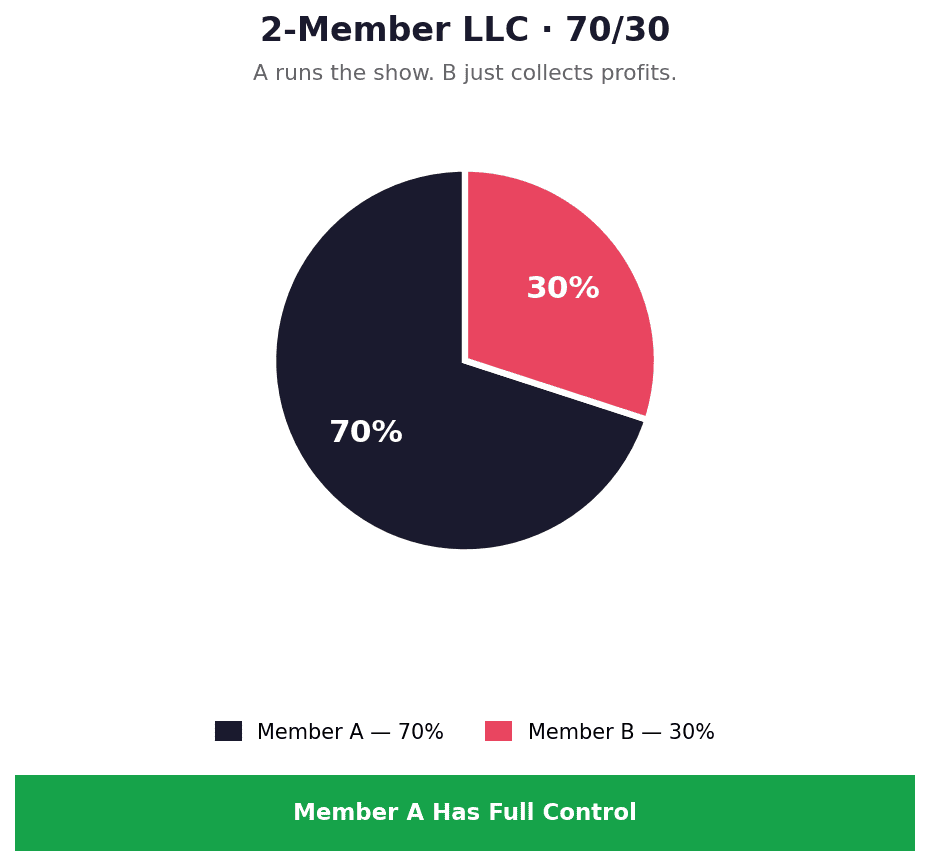
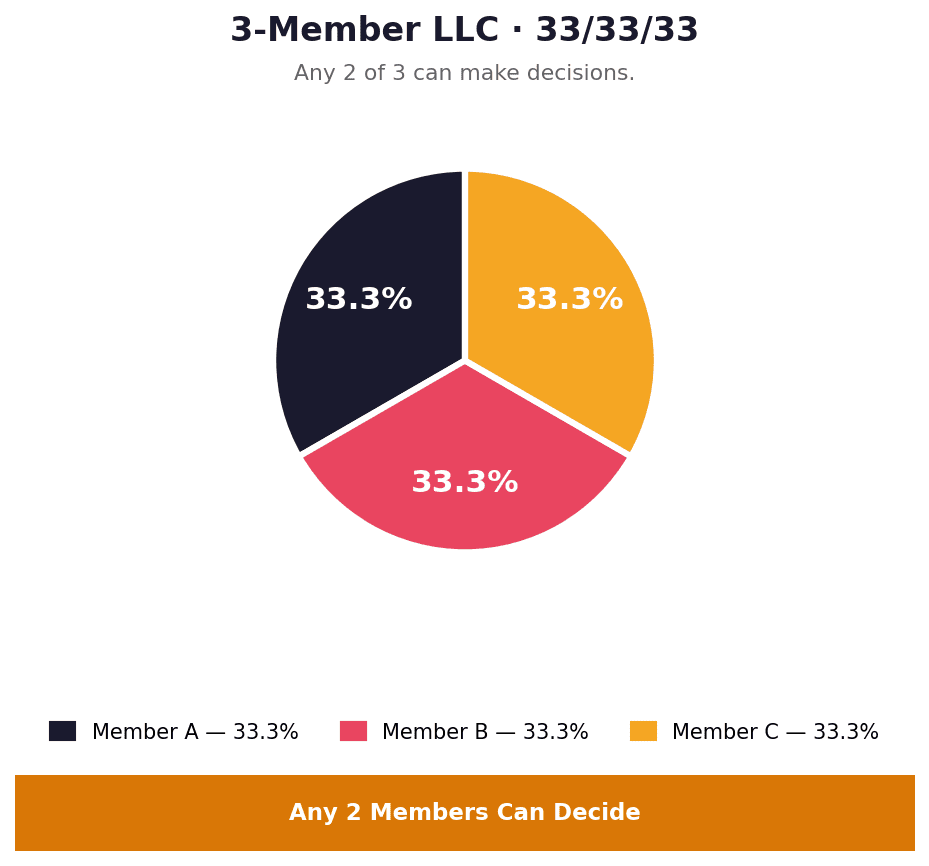
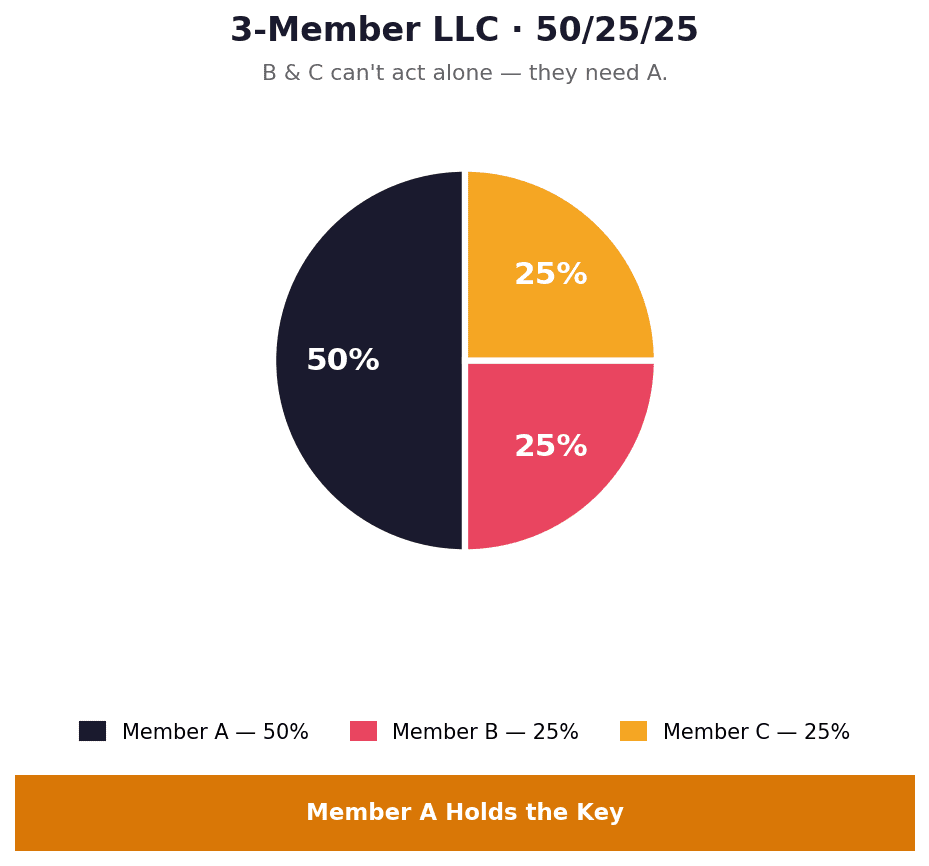
(5) Membership Voting: Except as otherwise may be required by the Articles of Organization, Certificate of Formation or a similar organizational document, other provisions of this operating agreement, or under the laws of this state, each member shall vote on any matter submitted to the membership for approval in proportion to the member’s percentage interest in this LLC. Further, unless defined otherwise for a particular provision of this operating agreement, the phrase “majority of members” means the vote of members whose combined votes equal more than 50% of the votes of all members in this LLC.
(6) Compensation: Members shall not be paid as members of the LLC for performing any duties associated with such membership, including management of the LLC. Members may be paid, however, for any services rendered in any other capacity for the LLC, whether as officers, employees, independent contractors or otherwise.
(7) Members’ Meetings: The LLC shall not provide for regular members’ meetings. However, any member may call a meeting by communicating his or her wish to schedule a meeting to all other members. Such notification may be in person or in writing, or by telephone, facsimile machine, or other form of electronic communication reasonably expected to be received by a member, and the other members shall then agree, either personally, in writing, or by telephone, facsimile machine or other form of electronic communication to the member calling the meeting, to meet at a mutually acceptable time and place. Notice of the business to be transacted at the meeting need not be given to members by the member calling the meeting, and any business may be discussed and conducted at the meeting. If all members cannot attend a meeting, it shall be postponed to a date and time when all members can attend, unless all members who do not attend have agreed in writing to the holding of the meeting without them. If a meeting is postponed, and the postponed meeting cannot be held either because all members do not attend the postponed meeting or the non-attending members have not signed a written consent to allow the postponed meeting to be held without them, a second postponed meeting may be held at a date and time announced at the first postponed meeting. The date and time of the second postponed meeting shall also be communicated to any members not attending the first postponed meeting. The second postponed meeting may be held without the attendance of all members as long as a majority of the percentage interests of the membership of this LLC is in attendance at the second postponed meeting. Written notice of the decisions or approvals made at this second postponed meeting shall be mailed or delivered to each non-attending member promptly after the holding of the second postponed meeting. Written minutes of the discussions and proposals presented at a members’ meeting, and the votes taken and matters approved at such meeting, shall be taken by one of the members or a person designated at the meeting. A copy of the minutes of the meeting shall be placed in the LLC’s records book after the meeting.
(8) Membership Certificates: This LLC shall be authorized to obtain and issue certificates representing or certifying membership interests in this LLC. Each certificate shall show the name of the LLC, the name of the member, and state that the person named is a member of the LLC and is entitled to all the rights granted members of the LLC under the Articles of Organization, Certificate of Formation or a similar organizational document, this operating agreement and provisions of law. Each membership certificate shall be consecutively numbered and signed by one or more officers of this LLC. The certificates shall include any additional information considered appropriate for inclusion by the members on membership certificates. In addition to the above information, all membership certificates shall bear a prominent legend on their face or reverse side stating, summarizing or referring to any transfer restrictions that apply to memberships in this LLC under the Articles of Organization, Certificate of Formation or a similar organizational document and/or this operating agreement, and the address where a member may obtain a copy of these restrictions upon request from this LLC. The records book of this LLC shall contain a list of the names and addresses of all persons to whom certificates have been issued, show the date of issuance of each certificate, and record the date of all cancellations or transfers of membership certificates.
(9) Other Business by Members: Each member shall agree not to own an interest in, manage or work for another business, enterprise or endeavor, if such ownership or activities would compete with this LLC’s business goals, mission, profitability or productivity, or would diminish or impair the member’s ability to provide maximum effort and performance in managing the business of this LLC.
III. TAX AND FINANCIAL PROVISIONS
(1) Tax Classification of LLC: For federal and, if applicable, state income tax purposes, this LLC will be taxed in its default tax classification, unless the members request an elective tax status from the IRS. The members also reserve the right to change the LLC’s tax classification at any time.
(2) Tax Year and Accounting Method: The tax year of this LLC shall be the calendar year. The LLC shall use the cash method of accounting. Both the tax year and the accounting period of the LLC may be changed with the consent of all members if the LLC qualifies for such change, and may be affected by the filing of appropriate forms with the IRS and state tax authorities.
(3) Tax Matters Partner: If this LLC is required under Internal Revenue Code provisions or regulations, it shall designate from among its members a “tax matters partner” in accordance with Internal Revenue Code Section 6231(a)(7) and corresponding regulations, who will fulfill this role by being the spokesperson for the LLC in dealings with the IRS as required under the Internal Revenue Code and Regulations, and who will report to the members on the progress and outcome of these dealings.
(4) Annual Income Tax Returns and Reports: Within 60 days after the end of each tax year of the LLC, a copy of the LLC’s state and federal income tax returns for the preceding tax year shall be mailed or otherwise provided to each member of the LLC, together with any additional information and forms necessary for each member to complete his or her individual state and federal income tax returns. If this LLC is classified as a partnership for income tax purposes, this additional information shall include a federal (and, if applicable, state) Form K-1 (Form 1065 - Partner’s Share of Income, Credits, Deductions) or equivalent income tax reporting form. This additional information shall also include a financial report, which shall include a balance sheet and profit and loss statement for the prior tax year of the LLC.
(5) Bank Accounts: The LLC shall designate one or more banks or other institutions for the deposit of the funds of the LLC, and shall establish savings, checking, investment and other such accounts as are reasonable and necessary for its business and investments. One or more members of the LLC shall be designated with the consent of all members to deposit and withdraw funds of the LLC, and to direct the investment of funds from, into and among such accounts. The funds of the LLC, however and wherever deposited or invested, shall not be commingled with the personal funds of any members of the LLC.
(6) Title to Assets: All personal and real property of this LLC shall be held in the name of the LLC, not in the names of individual members.
IV. CAPITAL PROVISIONS
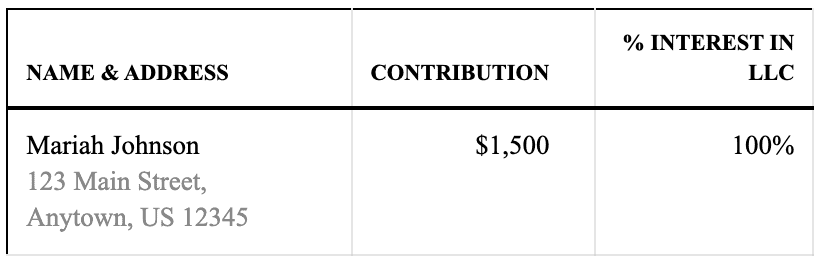
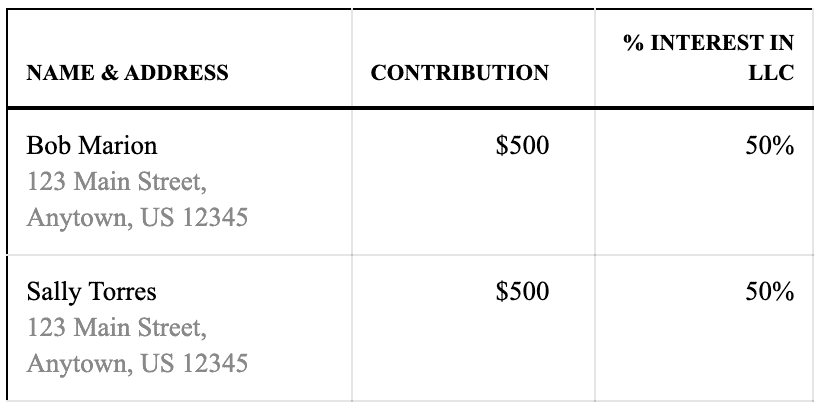
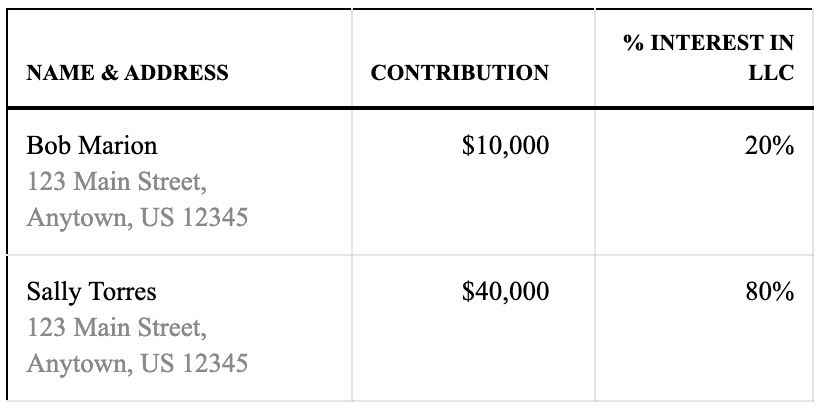
(1) Capital Contributions by Members: Members shall make the following contributions of cash, property or services as shown next to each member’s name below. Unless otherwise noted, cash and property described below shall be paid or delivered to the LLC on or by [DATE OF AGREEMENT]. The fair market values of items of property or services as agreed between the LLC and the contributing member are also shown below. The percentage interest in the LLC that each member shall receive in return for his or her capital contribution is also indicated for each member.
| NAME & ADDRESS |
CONTRIBUTION |
% INTEREST IN LLC |
[MEMBER {n} NAME]
[MEMBER {n} ADDRESS] |
[MEMBER {n} CAPITAL] |
[MEMBER {n} OWNERSHIP PERCENTAGE] |
[MEMBER 1 NAME]
[MEMBER 1 ADDRESS] |
[MEMBER 1 CAPITAL] |
[MEMBER 1 OWNERSHIP PERCENTAGE] |
(2) Additional Contributions by Members: The members may agree, from time to time by unanimous vote, to require the payment of additional capital contributions by the members, on or by a mutually agreeable date.
(3) Failure to Make Contributions: If a member fails to make a required capital contribution within the time agreed for a member’s contribution, the remaining members may, by unanimous vote, agree to reschedule the time for payment of the capital contribution by the late-paying member, setting any additional repayment terms, such as a late payment penalty, rate of interest to be applied to the unpaid balance, or other monetary amount to be paid by the delinquent member, as the remaining members decide. Alternatively, the remaining members may, by unanimous vote, agree to cancel the membership of the delinquent member, provided any prior partial payments of capital made by the delinquent member are refunded promptly by the LLC to the member after the decision is made to terminate the membership of the delinquent member.
(4) No Interest on Capital Contributions: No interest shall be paid on funds or property contributed as capital to this LLC, or on funds reflected in the capital accounts of the members.
(5) Capital Account Bookkeeping: A capital account shall be set up and maintained on the books of the LLC for each member. It shall reflect each member’s capital contribution to the LLC, increased by each member’s share of profits in the LLC, decreased by each member’s share of losses and expenses of the LLC, and adjusted as required in accordance with applicable provisions of the Internal Revenue Code and corresponding income tax regulations.
(6) Consent to Capital Contribution Withdrawals and Distributions: Members shall not be allowed to withdraw any part of their capital contributions or to receive distributions, whether in property or cash, except as otherwise allowed by this agreement and, in any case, only if such withdrawal is made with the written consent of all members.
(7) Allocations of Profits and Losses: No member shall be given priority or preference with respect to other members in obtaining a return of capital contributions, distributions or allocations of the income, gains, losses, deductions, credits or other items of the LLC. The profits and losses of the LLC, and all items of its income, gain, loss, deduction and credit shall be allocated to members according to each member’s percentage interest in this LLC.
(8) Allocation and Distribution of Cash to Members: Cash from LLC business operations, as well as cash from a sale or other disposition of LLC capital assets, may be distributed from time to time to members in accordance with each member’s percentage interest in the LLC, as may be decided by all of the members.
(9) Allocation of Noncash Distributions: If proceeds consist of property other than cash, the members shall decide the value of the property and allocate such value among the members in accordance with each member’s percentage interest in the LLC. If such noncash proceeds are later reduced to cash, such cash may be distributed among the members as otherwise provided in this agreement.
(10) Allocation and Distribution of Liquidation Proceeds: Regardless of any other provision in this agreement, if there is a distribution in liquidation of this LLC, or when any member’s interest is liquidated, all items of income and loss shall be allocated to the members’ capital accounts, and all appropriate credits and deductions shall then be made to these capital accounts before any final distribution is made. A final distribution shall be made to members only to the extent of, and in proportion to, any positive balance in each member’s capital account.
V. MEMBERSHIP WITHDRAWAL AND TRANSFER PROVISIONS
(1) Withdrawal of Members: A member may withdraw from this LLC by giving written notice to all other members at least 60 days before the date the withdrawal is to be effective.
(2) Restrictions on the Transfer of Membership: A member shall not transfer his or her membership in the LLC unless all non-transferring members in the LLC first agree to approve the admission of the transferee into this LLC. Further, no member may encumber a part or all of his or her membership in the LLC by mortgage, pledge, granting of a security interest, lien or otherwise, unless the encumbrance has first been approved in writing by all other members of the LLC. Notwithstanding the above provision, any member shall be allowed to assign an economic interest in his or her membership to another person without the approval of the other members. Such an assignment shall not include a transfer of the member’s voting or management rights in this LLC, and the assignee shall not become a member of the LLC.
VI. DISSOLUTION PROVISIONS
(1) Events That Trigger Dissolution of the LLC: The following events shall trigger dissolution of the LLC, except as provided:
(a) the death, permanent incapacity, bankruptcy, retirement, resignation or expulsion of a member, except that within 60 days of the happening of any of these events, all remaining members of the LLC may vote to continue the legal existence of the LLC, in which case the LLC shall not dissolve;
(b) the expiration of the term of existence of the LLC if such term is specified in the Articles of Organization, Certificate of Formation or a similar organizational document, or this operating agreement;
(c) the written agreement of all members to dissolve the LLC;
(d) entry of a decree of dissolution of the LLC under state law.
VII. GENERAL PROVISIONS
(1) Officers: The LLC may designate one or more officers, such as a President, Vice President, Secretary and Treasurer. Persons who fill these positions need not be members of the LLC. Such positions may be compensated or non-compensated according to the nature and extent of the services rendered for the LLC as a part of the duties of each office. Ministerial services only as a part of any officer position will normally not be compensated, such as the performance of officer duties specified in this agreement, but any officer may be reimbursed by the LLC for out-of-pocket expenses paid by the officer in carrying out the duties of his or her office.
(2) Records: The LLC shall keep at its principal business address a copy of all proceedings of membership meetings, as well as books of account of the LLC’s financial transactions. A list of the names and addresses of the current membership of the LLC also shall be maintained at this address, with notations on any transfers of members’ interests to nonmembers or persons being admitted into membership in the LLC.
Copies of the LLC’s Articles of Organization, Certificate of Formation or a similar organizational document, a signed copy of this operating agreement, and the LLC’s tax returns for the preceding three tax years shall be kept at the principal business address of the LLC. A statement also shall be kept at this address containing any of the following information that is applicable to this LLC:
- the amount of cash or a description and value of property contributed or agreed to be contributed as capital to the LLC by each member;
- a schedule showing when any additional capital contributions are to be made by members to this LLC;
- a statement or schedule, if appropriate, showing the rights of members to receive distributions representing a return of part or all of members’ capital contributions; and
- a description of, or date when, the legal existence of the LLC will terminate under provisions in the LLC’s Articles of Organization, Certificate of Formation or a similar organizational document, or this operating agreement.
If one or more of the above items is included or listed in this operating agreement, it will be sufficient to keep a copy of this agreement at the principal business address of the LLC without having to prepare and keep a separate record of such item or items at this address. Any member may inspect any and all records maintained by the LLC upon reasonable notice to the LLC. Copying of the LLC’s records by members is allowed, but copying costs shall be paid for by the requesting member.
(3) All Necessary Acts: The members and officers of this LLC are authorized to perform all acts necessary to perfect the organization of this LLC and to carry out its business operations expeditiously and efficiently. The Secretary of the LLC, or other officers, or all members of the LLC, may certify to other businesses, financial institutions and individuals as to the authority of one or more members or officers of this LLC to transact specific items of business on behalf of the LLC.
(4) Indemnification: The LLC shall indemnify the Member and those authorized officers, agents, and employees of the LLC identified in writing by the Member as entitled to being indemnified under this section for all costs, losses, liabilities and damages paid or accrued by the Member (as the Member or officer, agent, or employee) or any such officer, agent, or employee in connection with the business of the LLC, except to the extent prohibited by the laws of the state that governs this Agreement. In addition, the LLC may advance costs of defense of any proceeding to the Member or any such officer, agent, or employee upon receipt by the LLC of an undertaking by or on behalf of such person to repay such amount if it shall ultimately be determined that the person is not entitled to be indemnified by the LLC.
(5) Mediation and Arbitration of Disputes Among Members: In any dispute over the provisions of this operating agreement and in other disputes among the members, if the members cannot resolve the dispute to their mutual satisfaction, the matter shall be submitted to mediation. The terms and procedure for mediation shall be arranged by the parties to the dispute. If good-faith mediation of a dispute proves impossible or if an agreed-upon mediation outcome cannot be obtained by the members who are parties to the dispute, the dispute may be submitted to arbitration in accordance with the rules of the American Arbitration Association. Any party may commence arbitration of the dispute by sending a written request for arbitration to all other parties to the dispute. The request shall state the nature of the dispute to be resolved by arbitration, and, if all parties to the dispute agree to arbitration, arbitration shall be commenced as soon as practical after such parties receive a copy of the written request. All parties shall initially share the cost of arbitration, but the prevailing party or parties may be awarded attorney fees, costs and other expenses of arbitration. All arbitration decisions shall be final, binding and conclusive on all the parties to arbitration, and legal judgment may be entered based upon such decision in accordance with applicable law in any court having jurisdiction to do so.
(6) Governing Law: This Agreement shall be governed by, and interpreted and enforced in accordance with, the substantive laws of the State in which the LLC was formed, without reference to the conflicts of law rules of that or any other jurisdiction.
(7) Entire Agreement: This operating agreement represents the entire agreement among the members of this LLC, and it shall not be amended, modified or replaced except by a written instrument executed by all the parties to this agreement who are current members of this LLC as well as any and all additional parties who became members of this LLC after the adoption of this agreement. This agreement replaces and supersedes all prior written and oral agreements among any and all members of this LLC.
(8) Severability: If any provision of this agreement is determined by a court or arbitrator to be invalid, unenforceable or otherwise ineffective, that provision shall be severed from the rest of this agreement, and the remaining provisions shall remain in effect and enforceable.
VIII. SIGNATURES OF MEMBERS
Execution of Agreement: In witness whereof, the members of this LLC sign and adopt this agreement as the operating agreement of this LLC.
| Date: |
[DATE OF AGREEMENT] |
| Signature: |
________________________________________ |
| Printed Name: |
[MEMBER {n} NAME], Member |
| Date: |
[DATE OF AGREEMENT] |
| Signature: |
________________________________________ |
| Printed Name: |
[MEMBER 1 NAME], Member |
OPERATING AGREEMENT FOR
[LLC NAME]
A MANAGER-MANAGED LLC
Article I
Company Formation
1.1 FORMATION. The Members have formed a Limited Liability Company (“Company”) subject to the laws of the state in which it was formed. This operating agreement is entered into and effective upon adoption by the Member(s).
1.2 REGISTERED AGENT. The name and location of the Company’s registered agent will be as stated in the formation documents.
1.3 TERM. The Company will continue perpetually unless, (a) Members unanimously vote for dissolution; or (b) An event occurs which causes the Company’s business to become unlawful; or (c) Any other event causing the Company’s dissolution under state laws.
1.4 CONTINUANCE OF COMPANY. In the event of an occurrence described in ARTICLE 1.3(c), if there is at least one remaining Member, the Member has the right to continue the Company’s business.
1.5 BUSINESS PURPOSE. The purpose of the Company is to conduct any and all lawful business activities appropriate in carrying out the company’s objectives.
1.6 PRINCIPAL PLACE OF BUSINESS. The location of the Company’s principal place of business will be as stated in the formation documents or as selected by the Managers.
1.7 THE MEMBERS. The name and address of each Member is contained in Exhibit 2, attached to this Agreement.
1.8 ADMISSION OF ADDITIONAL MEMBERS. Members may only be admitted to the Company through issuance of a new interest in the company with unanimous written consent of the Members or the sale of a Member’s current interest, except as otherwise expressly provided in the Agreement.
Article II
Capital Contributions
2.1 INITIAL CONTRIBUTIONS. The Members will contribute the Company’s initial capital as described in Exhibit 3 attached to this Agreement. The agreed total value of such property and cash is [SUM OF ALL MEMBERS CAPITAL].
2.2 ADDITIONAL CONTRIBUTIONS. Except as provided in ARTICLE 6.2, no Member is obligated to make any additional contribution to the Company’s capital.
Article III
Profits, Losses and Distributions
3.1 PROFITS/LOSSES. For financial accounting and tax purposes the Company’s net profits or net losses will be determined annually. Profits and losses will be allocated to the Members in proportion to each Member’s relative capital interest in the Company as set forth in Exhibit 2 as amended and in accordance with Treasury Regulation 1.704-1.
3.2 DISTRIBUTIONS. The Members may determine and distribute available funds annually or more frequently as the Members see fit. “Available funds” refers to the net cash of the Company available after expenses and liabilities, as determined by the Managers. Upon liquidation of the Company or of a Member’s interest, distributions must be made according to the positive capital or pursuant to Treasury Regulation 1.704-l(b)(2)(ii)(b)(2). To the extent a Member has a negative capital account balance, there must be a qualified income offset, as set forth in Treasury Regulation 1.704-l(b)(2)(ii)(d).
Article IV
Management
4.1 MANAGEMENT OF THE BUSINESS. The Company is managed by a Manager or Managers. The Manager(s) may be Members or Non-Members. The name and address of each Manager is attached as Exhibit 1 of this Agreement. The Manager(s) will be elected by a majority vote of the Members.
4.2 MEMBERS. The liability of the Members is limited pursuant to applicable state law. Members that are not Managers may not take any part in the control, management, direction, or operation of the Company’s affairs and have no power to bind the Company. The Members may advise the Managers, but Managers are not required to accept such advice. The Managers have the exclusive right to control and manage the Company. No Member will be an agent of any other Member of the Company solely by reason of being a Member.
4.3 POWERS OF MANAGERS. The Managers are authorized to make all decisions regarding the Company’s operations and legal affairs, including but not limited to:
(a) the sale, development, lease or other disposition of the Company’s assets;
(b) the purchase or other acquisition of other assets of all kinds;
(c) the management of all or any part of the Company’s assets;
(d) the borrowing of money and the granting of security interests in the Company’s assets;
(e) the pre-payment, refinancing or extension of any loan affecting the Company’s assets;
(f) the compromise or release of any of the Company’s claims or debts; and,
(g) the employment of persons, firms or corporations for the operation and management of the Company’s business. Managers are authorized to execute and deliver (1) all contracts, conveyances, assignments leases, sub-leases, franchise agreements, licensing agreements, management contracts and maintenance contracts covering or affecting the Company’s assets; (2) all checks, drafts and other orders for the payment of the Company’s funds; (3) all promissory notes, loans, security agreements and other similar documents; and, (4) all other instruments of any other kind relating to the Company’s business.
4.4 NOMINEE. Title to the Company’s assets will be held in the Company’s name or in the name of any nominee that the Managers may designate. The Managers will have power to enter into a nominee agreement with any person, and such agreement may contain provisions indemnifying the nominee, except for his or her willful misconduct.
4.5 COMPANY INFORMATION. Upon request, the Managers will supply to any member, information regarding the Company or its activities. Any Member or a member’s authorized representative may access, inspect, and copy all books, records and materials in the Manager’s possession regarding the Company or its activities. These rights may be exercised at the requesting Member’s expense.
4.6 EXCULPATION. Any act or omission of the Managers, the effect of which may cause or result in loss or damage to the Company or the Members, if done in good faith to promote the best interests of the Company, will not subject the Managers to any liability.
4.7 INDEMNIFICATION. The Company will indemnify any person who was or is a party defendant or is threatened to be made a party defendant, in a pending or completed action, suit or proceeding, whether civil, criminal, administrative, or investigative (other than an action by or in the right of the Company) by reason of the fact that the person is or was a Member of the Company, employee, or agent of the Company, or is or was serving at the request of the Company. The termination of any action, suit, or proceeding by judgment, order, settlement, conviction, or upon a plea of “no lo Contendere” does not imply that the party did or did not act in good faith and in a manner which he/she reasonably believed to be lawful and in the best interest of the Company.
4.8 RECORDS. The Managers must keep the following at the Company’s principal place of business:
(a) A copy of all formation documents, the operating agreement, and any amendments;
(b) A current list of the full name and the last known street address of each Member;
(c) Copies of the Company’s federal, state and local income tax returns and reports, if any, for the three most recent years;
(d) Copies of the Company’s financial statements for the three most recent years.
Article V
Compensation
5.1 MANAGEMENT FEE. Any Manager rendering services to the Company is entitled to compensation equal to the value of those services.
5.2 REIMBURSEMENT. The Company will reimburse the Managers or Members for all direct out-of-pocket expenses incurred in managing the Company.
Article VI
Bookkeeping
6.1 BOOKS. The Managers will keep complete and accurate accounting of the Company’s affairs at the Company’s principal place of business or other location agreed upon by the Managers. The Managers will choose the method of accounting and the Company’s accounting period will be the calendar year.
6.2 MEMBER’S ACCOUNTS. The Managers must maintain separate capital and distribution accounts for each Member. Each Member’s capital account must be determined and maintained in the manner set forth in Treasury Regulation 1.704-l(b)(2)(iv) and will consist of the Member’s initial capital contribution increased by:
(a) Any additional capital contribution made by the Member;
(b) Credit balances transferred from the member’s distribution account to the member’s capital account;
and decreased by:
(1) Distributions to the Member in reduction of Company capital;
(2) The Member’s share of Company losses if charged to the Member’s capital account.
6.3 REPORTS. When the Managers close the books at the close of each calendar year, the Managers will prepare and send to each Member, a statement of that Member’s distributive share of income and expense for income tax reporting purposes.
Article VII
Transfers
7.1 ASSIGNMENT. If a Member proposes to sell, assign or otherwise dispose of all or part of the Member’s interest in the Company, he or she must comply with the following procedures:
(a) First make a written offer, including the price, to sell such interest to the other Member(s). The exiting Member may only advertise the sale if the other Members decline or fail to elect such interest within 60 days after the offer.
(b) If the exiting member has a buyer of interest, the other current Member(s) have first right of refusal to purchase the exiting Member’s interest for the agreed purchase price. If there is more than one current remaining Member, the remaining Members may combine funds to purchase the exiting Members’ interest. The exiting Member must show that potential purchaser has full certified funds, or the ability to get full certified funds before the 60 day right of first refusal period ends.
(c) Current Members must unanimously approve the sale of exiting Members’ interests to grant full membership benefits and functionality to the new Member. If the current remaining Members do not unanimously approve the sale, the purchaser or assignee will have no management or voting rights. The purchaser or assignee is only entitled to receive the share of the profits or other compensation by way of income and the return of contributions to which that Member would otherwise be entitled. The exiting Member must disclose to the buyer or assignee if the current Members will not approve the sale.
7.2 VALUATION OF EXITING MEMBERS INTEREST. If a Member wants to exit the LLC, and does not have a buyer of its membership interest, exiting Member will assign its interest to current Members according to the following procedures:
(a) A value must be placed upon this membership interest before being assigned.
(b) If the exiting Member and the current Members do not agree on the value of the membership interest, the exiting Member must pay for a certified appraiser to assess the Company’s value. The appraiser will assign the exiting Members’ interest a value according to the exiting Members’ interest percentage.
(c) The current Members must approve the certified appraiser used by exiting Member. Current Members have 30 days to approve the exiting Members certified appraiser. If current Members disapprove the certified appraiser, they must show evidence to support their disapproval of the certified appraiser as a vendor qualified to appraise the company. Current Members may not stall the process by disapproving all certified appraisers.
(d) When a certified appraiser places a value on the Company, a value will be placed on the exiting Members’ interest according to exiting Members’ percentage of membership interest.
(e) If current Members disagree with the value placed on exiting Members’ interest, current Members must pay for a certified appraiser to value the company and the exiting Members’ interest according to the same terms.
(f) Current Members’ appraisal must be completed within 60 days or right of current Members to dispute the value of exiting Member’s interest expires.
(g) Upon completion of current Members’ appraisal, the exiting Member must approve the value placed on exiting Members’ interest. Exiting Member has 30 days to approve this value.
(h) If the exiting Member does not approve the current Members’ appraised value, then the value of the Company will be determined by adding both parties’ appraised values, then dividing that value in half, creating the value of the exiting Members’ interest.
7.3 DISTRIBUTION OF EXITING MEMBERS INTEREST. Upon determination of exiting Members’ interest value, the value will be a debt of the Company. The exiting Member will only be able to demand payment of this debt at dissolution of the Company or by the following method:
(a) The Company will make timely payments.
(b) The Company will only be required to make payments towards exiting Member’s debt if the Company is profitable and passes income to current Members.
(c) The Company must make a debt payment to the exiting Member if the Company’s income surpassed 50% of the total determined value of the exiting Members’ interest in one taxable year. (Example: If exiting Members’ value was $100,000 and current Member(s) received over $50,000 taxable income in the taxable year, the LLC would owe a debt payment to exiting Member. If current Member(s) only received $40,000 in passed income, there would be no payment due.)
(d) The debt payment must be at least 10% of the value of the passed income to current Members.
(e) The company must make payment to exiting Member within 60 days of the end of the company’s taxable year.
(f) The payment schedule will continue until the exiting Member’s debt is paid.
(g) If the Company dissolves, the exiting Member will be a regular debtor and payment will follow normal dissolution payment statutes.
(h) The exiting Member’s value of membership interest assigned current Members may NOT accrue interest.
(i) The Company may pay the amount owed to the exiting Member at any time.
Article VIII
Dissolution
8.1 DISSOLUTION. The Member(s) may dissolve the LLC at any time. The Member(s) may NOT dissolve the LLC for a loss of membership interests.
Upon dissolution the LLC must pay its debts first before distributing cash, assets, and/or initial capital to the Member or the Members interests. The dissolution may only be ordered by the Member(s), not by the owner of the Member’s interests.
Certification of Members
The undersigned hereby agree, acknowledge, and certify that the foregoing operating agreement is adopted and approved by each Member, the agreement consisting of [TOTAL PAGE COUNT] pages, constitutes, together with Exhibit 1, Exhibit 2, and Exhibit 3, the Operating Agreement of [LLC NAME], adopted by the Members as of [DATE OF AGREEMENT].
Members:
__________________________________________
[MEMBER {n} NAME]
Membership interest: [MEMBER {n} OWNERSHIP PERCENTAGE]
__________________________________________
[MEMBER 1 NAME]
Membership interest: [MEMBER 1 OWNERSHIP PERCENTAGE]
Exhibit 1
LIMITED LIABILITY COMPANY OPERATING AGREEMENT FOR
[LLC NAME]
Listing of Managers
By a majority vote of the Members the following Managers were elected to operate the Company pursuant to ARTICLE 4 of the Agreement:
_______________________________
[MANAGER {n} NAME], Manager
[MANAGER {n} FULL ADDRESS]
_______________________________
[MANAGER 1 NAME], Manager
[MANAGER 1 FULL ADDRESS]
The above listed Manager(s) will serve in their capacities until they are removed for any reason by a majority vote of the Members as defined by ARTICLE 4 or upon their voluntary resignation.
Signed and agreed on [DATE OF AGREEMENT].
__________________________________________
[MEMBER {n} NAME], Member
__________________________________________
[MEMBER 1 NAME], Member
Exhibit 2
LIMITED LIABILITY COMPANY OPERATING AGREEMENT FOR
[LLC NAME]
Listing of Members
As of [DATE OF AGREEMENT], the following is a list of Members of the Company:
| Name: |
[MEMBER {n} NAME] |
| Membership interest: |
[MEMBER {n} OWNERSHIP PERCENTAGE] |
| Address: |
[MEMBER {n} FULL ADDRESS] |
| Name: |
[MEMBER 1 NAME] |
| Membership interest: |
[MEMBER 1 OWNERSHIP PERCENTAGE] |
| Address: |
[MEMBER 1 FULL ADDRESS] |
Authorized by Member(s) to provide Member Listing as of [DATE OF AGREEMENT].
__________________________________________
[MEMBER {n} NAME], Member
__________________________________________
[MEMBER 1 NAME], Member
Exhibit 3
LIMITED LIABILITY COMPANY OPERATING AGREEMENT FOR
[LLC NAME]
Capital Contributions
Pursuant to ARTICLE 2, the Members’ initial contribution to the Company capital is stated to be [SUM OF ALL MEMBERS CAPITAL]. The description and each individual portion of this initial contribution is as follows:
| [MEMBER {n} NAME], by cash/check/money order: |
[MEMBER {n} CAPITAL] USD |
| [MEMBER 1 NAME], by cash/check/money order: |
[MEMBER 1 CAPITAL] USD |
SIGNED AND AGREED on [DATE OF AGREEMENT].
__________________________________________
[MEMBER {n} NAME], Member
__________________________________________
[MEMBER 1 NAME], Member




Hi Matt.
How do we establish a beneficiary to a multi member LLC (both members are really the same individual).
Hi Debra, can you rephrase the question and include some more context? I don’t fully understand. Thank you.
Hi Matt,
I am about to form a Single-Member LLC here in Florida.
I understand that in the state of Florida a SMLLC is not offered the same asset protections that is provided to a multi-member LLC.
Is this true, and if so, how does one go about protecting personal assets?
I own my own home and vehicle.
Is it better to file a Manager vs an Authorized Member?
Thank You,
Kathleen C.
Hi Kathleen,
Is it better to file a Manager vs an Authorized Member?
I’d personally file as a Manager (MGR) in Florida. Reason why is it offers a bit more privacy. This will mean that your LLC is Manager-Managed (see Member-Managed vs Manager-Managed LLC).
And regarding asset protect yes, you are correct.
Single-Member LLC vs. Multi-Member LLC in Florida:
In Florida, a Multi-Member LLC typically offers stronger asset protection (compared to a Single-Member LLC) due to what’s called “charging order protection“.
Charging order protection means that if an LLC Member (owner) is personally sued, a creditor can’t directly access the LLC’s assets (or take over control of the LLC itself). Instead, the creditor can seek to obtain a “charging order”. This only gives them the right to receive any distributions that the LLC makes to that Member. They cannot seize LLC assets directly.
However, this protection clearly applies only to Multi-Member LLCs in Florida. A key Florida Supreme Court case, Olmstead v. FTC, 44 So.3d 76 (Fla. 2010), established that creditors of Florida Single-Member LLC owners could directly reach the owner’s interest in the LLC, effectively eliminating charging order protection for Single-Member LLCs.
Having said that, a Single-Member LLC still protects your personal assets (such as your home, car, and personal bank accounts) if your LLC is sued.
Again, charging order protection (or lack of) only applies if you’re personally sued. And even then, a series of events would need to occur before there was an attack on your LLC
This scenario also assumes your LLC holds valuable assets worth pursuing.
Having said all that, here are some options to strengthen your asset protection:
1. Personal Umbrella Insurance (and car insurance coverage)
2. Convert to a Multi-Member LLC (adding another member)
3. Consider forming a Wyoming LLC as a Holding Company that owns your Florida LLC
In summary, this whole topic can get pretty complicated. And you might not need a super robust setup like the above. However, to explore this area more, I’d recommend speaking with a couple asset protection attorneys. Hope that helps!
My wife and her sister will be inheriting a rental condo in Florida soon that their 96 year old father will pass to them upon his passing. He recently was put in hospice and it is a matter of weeks or months for his passing. My wife is a Florida resident and her sister is an Illinois resident. They want to create an LLC in Florida to place the property in. There will be two to four members. What is the best entity classification for tax purposes? Or will they be treated as a Partnership no matter the classification (S corp, C corp, etc)? Lastly, her sister in Illinois already has an LLC in Illinois. Should that LLC be a member to satisfy the foreign LLC needs? Thank you in advance for your insight.
Hi Ken, I wouldn’t make the Illinois LLC a Member in this case. It sounds unnecessary. Since it’s a rental condo in Florida, a Florida LLC will be the simplest. By default, Multi-Member LLCs are taxed like Partnerships (please LLC taxed as Partnership). You can make an election to instead have the LLC taxed as an S-Corp or C-Corp, but I wouldn’t recommend that in this situation. Hope that helps.
How can I assign 50% of my ownership in a Florida LLC. I own 20% interest in the subject LLC.
Hi AJ, I’m not sure what you mean by 20% of a subject LLC, but in general, here’s how you would assign ownership interest of an LLC in Florida:
What can be done if a Fl llc with 2 equal members was changed by one member to a manager-managed llc without the knowledge or consent of the 2nd member ? And the now Manager is making decisions without any regard to the other member.
Hi Mary, this is most likely a breach of the Operating Agreement and isn’t legal. If material, I’d chat with an attorney or two for the best course of action.
One more question Matt!
Basically, for tax purpuses, I’m trying to figure out if I filed my fiance’s LLC correctly on the IRS page when I applied to get the bussiness EIN number. The IRS sent my fiance the comfirmation letter with EIN number included, stating that the company is under Johanhaul, LLC/Name of my Fiance (ommited the name of my fiance here for secury purpuses), Sole MBR. In this case, is the bussiness still a separate entity from my fiance’s personal assets? Meaning, in case of a law suit, and/or for tax purpuses, is my fiance personal assets apart from the company when filing taxes? Our intention was to keep both separate.
The reason I ask is because of the satatement below:
“According to the IRS, a single-member limited liability company is a “disregarded entity”, meaning there is no separation between the business and its owner. By default, the IRS taxes it the same as a sole proprietorship.”
Thanks again Matt!
Hey Donna, that is about tax treatment only, and not about state law and asset protection. So the LLC your fiancé set up still offers personal asset protection. From a legal stand point, the assets of the business are separate from the assets of your fiancé. However, from an IRS tax standpoint, your fiancé is responsible for any taxes for the LLC. Hope that helps.
You are the BEST!
Thanks so much Matt! You literally saved me $160 already!
I thought I made a mistake when using the tittle “manager” when I registered the LLC with the Flrodia Division of Coorporations, and also when I registered the company with the IRS. So, it looks like I did both right from the begining. Thanks God I found you! :-)
Do you offer any classes or consulting? You are worth spending my money in! :-) Thank you for sharing your expertice!
Thanks again Matt!
Haha, thanks so much Donna! I don’t offer classes or consulting at this time, however, if you have any questions, I can likely guide you to the answer on our site, or help you here in the comments. And you’re very welcome! Super happy to help!
Hi Matt!
In a manager-managed sole proprietor LLC. Can the designated manager (in this case it’s me, and I’m not a member of the LLC; filed in Florida), choose not to be compensated by the services rendered as manager? If so, how do we add that in the Operating Agreement? I’m assuming it will be under “ARTICLE V: Compensation-
5.1 MANAGEMENT FEE” correct? Basically, I’m just helping my fiancé run his trucking business, and need the authority to do so, but I don’t want to be a member of his LLC nor him or me be taxed for my “manager” role. I hope this makes sense. lol
Thanks so much!
Hi Donna! Yes, you can still be an LLC Manager (that is a non-Member) and receive no compensation. And yes, that would be the section to edit the Operating Agreement. Hope that helps.
Thank you so much Matt!
You’re welcome Donna :)
Can we open LLC bank account before LLC .
If one of 2 members is going to pass away, can another one have 100% LLC and should be bank account number changed or not.
Hi Nina, no, you can’t open an LLC bank account until the LLC is approved. If one Member will soon be passing away, it’s often better for them to create a Trust and their Trust be an LLC Member. You’ll want to speak with an estate planning attorney for that. Hope that helps.
I would like to open an LLC, however I am not a US Resident or Citizen, but my partner is a Citizen. We intend to apply for a EIN number, but I’m unsure of how would that work in regards to IRS. Could you advise?
Thanks so much.
Hi Natalia, it’s okay. There are no citizenship or residency requirements to forming an LLC in Florida. And as for the IRS, only 1 person needs to be listed as the LLC EIN Responsible Party. If your partner wants to obtain the EIN, it can be done online: apply for LLC EIN online. If you want to obtain the EIN, you need to mail or fax Form SS-4. Please see here: Get LLC EIN without SSN. Will be visiting Florida in person to open an LLC bank account? You’ll also want to speak with an accountant regarding any tax filings you may have. Make sure to work with an accountant who specializes in working with non-US residents. We recommend Gary at GW Carter. Hope that helps.
Hi Matt , i italian and lives in Italy . i m process to open LLC company in Florida , with two partners …i ve got two past business in Florida and i loose money because my ex-partner , no was honest …i would add a decalogue/handbook for members in LLC …i can add that rules and all members sign …i can send you my decalogue and you add in LLC Agrement and how do charge for that ? please let me know
Hi Francesco, we don’t offer Operating Agreement review or contract services at this time. Thank you for your understanding.
My husband put my name as well as his on the Article of Application Section 4 as a member, thinking this would protect the company if anything should happen to him. But now I am concerned we will be considered a “partnership” by the IRS, which we technically are not. Should he remove me as a member since I don’t materially participate in the company? I don’t want to have any shares and that would be subject to additional taxation forms/filing, it was merely to protect the LLC in event of his death.
Hi Lisa, I believe you mean Article 4 of the Articles of Organization. Your LLC will only be taxed as a Partnership if you apply for an EIN and list that there are 2 Members. That’s what the IRS goes off of. Meaning, the IRS doesn’t automatically get a copy of your Articles of Organization (unless you were to send it to them). Correct, you are not a Partnership, but an LLC with 2 or more Members is treated as a Partnership for federal tax purposes (related article: how are LLCs taxed). Also, the amount of taxes paid in an LLC taxed as a Sole Proprietorship and an LLC taxed as a Partnership will be the same. Your accountant may charge a tiny bit extra, since a 1065 Partnership return is needed in addition to your personal tax return(s), either filed jointly or separately. I’m not sure if you need to materially participate in the LLC in order to be a Member. That would be a question for an attorney in Florida. And how LLC membership interests are treated upon a Member’s death can be handled in a number of different ways. I’d say overall, before you do anything, you should speak with an attorney familiar with LLC formation as well as estate planning. If you do decide to remove yourself from the Florida LLC’s Articles of Organization, you’ll need to file an “Articles of Amendment to Articles of Organization“. Hope that helps.
Hi Matt,
Do you have any references/suggestions on other agreement templates that may come up for an LLC? Two that readily come to mind are general services contract for a consulting firm or hiring contractors to perform certain task for the LLC ( ie. someone not an owner in the company, but has a specialized skillset that you want to utilize on a contractual basis?)
Hi David, that is a great idea, but we don’t offer something like that right now. I recommend hiring a lawyer to get contracts written that are specific to your situation. Thanks for understanding.
Thank you for the quick reply!
Dears,
I’m foreigner who wants to form a LLC in Florida. Also I’m not a US resident, I live in Brazil to be more specific
After I filled the articles of organization with all informations, is it necessary to send some additional documents to form the LLC? Whether yes, which documents do I need to send? How may I send it?
The other question that I have is about the EIN. To have one do I need to fill the ITIN? Because I’m an alien.
Best Regards.
Amos Anjos.
Rio de Janeiro, Brazil.
Hi Amos, you do not need to be a US resident to form an LLC in Florida (or in any state). After your Articles of Organization, complete an Operating Agreement, and then obtain your Federal Tax ID Number. Since you don’t have a US social security number, you cannot obtain the EIN online… however, you can obtain an EIN by mail or fax. You’ll need to complete Form SS-4 (IRS Form SS-4) and then mail or fax it to the IRS. On line 7b, just write “Foreign”. Fax is the recommended method since the approval time is much faster. The fax number to use is 855-641-6935. Also, make sure to file your Florida LLC’s Annual Report every year. Hope that helps!